
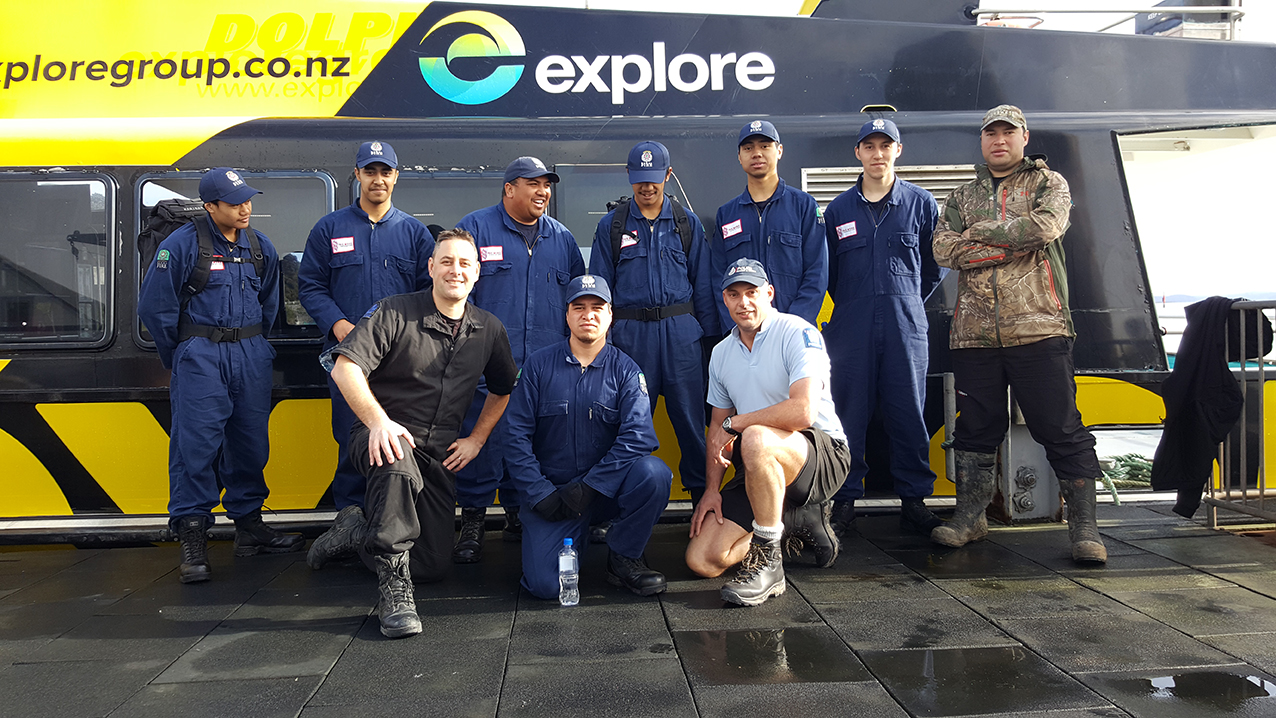
Last year the Northern Rural Fire Authority, based in Kaikohe, ran a cadet programme. The idea was to get more young recruits into their service and to do something for their community where youth unemployment is high. It was the Authority’s first venture into community education. They planned a course that would run for two days a week for 16 weeks, during which time the cadets would complete up to six NZQA Unit Standards on firefighting techniques and safety. They decided not to advertise but to get a group of 16-24 year olds through WINZ. In many ways the programme didn’t turn out as planned but what it did show is that a programme that supports marginalised young men, mentoring them and helping them learn some basic skills can shift their pathway - for the better. Most of the ten young people who did the programme (most of whom came with a range of very complex needs) used the experience as the first step towards work or further education.
Clinton Lyall (Whakatohea), Deputy Principal Rural Fire Officer now with Fire and Emergency (the rural Fire Authority has now been amalgamated into Fire and Emergency New Zealand), was the man behind the programme. He talked to us about what they did:
“Our board was very supportive of this initiative. I had friends in the police and in the army and they were keen to get involved with these young people too: Inspector Chris McLellan and Constable Marco Van den Broek, NZ Police Northland and Staff Sargent Eddie Bellas NZ Army.
“We were aware of the KODE (Kaikohe Opportunities Dreams and Empowerment) project run the year before but were not in a position at the time to help out. So we set up our programme with quite a lot of community involvement. The Moko Foundation came on board before the programme began sponsoring running shoes and overalls. Patu Kaikohe provided free training sessions and facilities were made available for the cadets to use. Patu is an initiative supported by the northern Rural Fire Authority to help improve the health of its community. Kerikeri Community Fitness Centre carried out sessions for the cadets; Kerikeri Chemists sponsored toiletry product for each of the recruits; the Department of Conservation sponsored gear bags; Explore NZ Paihia provided transport to for a field trip; and Taratahi (a rural training provider), collaborated by offering two cadets keen to do a full week programme, the opportunity to come into their programme for three days each week.
“We knew we weren’t offering them a job at the end. Everyone has to go through a recruitment process, but we wanted to let them know that there is an opportunity for them to volunteer as a rural firefighter. We ran a couple of seminars for people that WINZ referred – telling them about the programme and ten signed up. We could have taken about 20. Some girls signed up but in the end they did not join the course.
“Quite early on we could see that they were not going to do the unit standards. We started them on it but they just didn’t know how to learn and we are not teachers. So we ran a programme that was really about mentoring them, and teaching them what is acceptable behaviour: why people should respect you and why you should respect them. Right back to the basics really. WINZ had referred people on for literacy support. We had one guy who did have literacy problems and we worked with him independently. We got them involved in fitness training, and doing practical things based around firefighting and discipline. We also pushed that once you are in work, that’s where the benefit ends. If you don’t like that job you find another job before leaving. The benefit shouldn’t be a safe place to default to.
“We divided the programme up among our trades, but some of the basics are similar through our own professions. Discipline and fitness for example.
“One time Chris, Marco and Eddie took them to Urupukapuka Island for a search and rescue exercise, courtesy of Explore NZ which Chris had arranged. While travelling over there, they got to swim with dolphins. Which was totally left field for this group.
“Most of the time the attendance was good. It was somewhere for them to go instead of hanging out on the streets. They felt safe here. First we didn’t think we would provide food, but when we realised the situation that many of them were in we did. One young guy who I saw absolutely devouring some chicken told me that both of his parents were on a sickness benefit. He said we just can’t afford meat in our family – we just can’t afford it. He wanted a job so he can support his mum and dad and his other siblings. And after any exercise they were all off to have a hot shower. One guy lived in a house with no electricity – he washed in a stream. He just loved having a hot shower in the depot.
“For us it was a realisation of just how good these kids are. They were really fun to work with. They had a good sense of humour, they were enthusiastic and keen to learn even though sometimes it was like being in a room with a bunch of five-year olds! The trouble was many of them were on drugs. We drug tested them, but after a couple of weeks off drugs they became very irritable. We had lots of laughs. We were all in fits at times. They were just so amusing. We all learned.
 “Because they were still young guys they still looked up to the police. Police still have mana. One guy who was quite fascinated with the police said he would like to join. He had no criminal record and Chris told him that if he got himself some education he could. He is still quite keen. The police took him out on patrol to see what it was like.
“I think some of them learned some leadership skills. I talked with one guy about becoming a mentor for young people, and he said do you mean I could be a mentor for my little brother? And I said, exactly. The thing is that a lot of women are stepping up in this community, but these young guys – they need to be next to men. They need good solid, male role models. I think our agencies can provide this. And we should provide it.
“The idea was to keep in touch with them, follow them up and help them into employment. But a lot of these guys are transient. They change their cell phone numbers all the time, and we lost touch with them. But Jo Littin from WINZ tells me that most of them are now working or in courses. I know that the guy whose parents are on a sickness benefit is working in McDonalds, is loving it and is providing for his family, and another has become a scaffolder in Auckland. This is his second job since leaving the course as the first job, building, came to an end. He was 24 and had never had a full time job in his life. He tested positive for drugs when he started. By the time he left us he was clear of drugs in the system. He said he had been on drugs since he was 13. Just one guy became a fire cadet. We gave him a 40 week contract.
“Chris and I had both discussed giving up our jobs to do this. But I pointed out, that what gets us through the door is our uniforms. Without our uniforms we would be just two guys.
“I don’t know whether under our amalgamated service we will be able to run the programme again, but if we did I would make it shorter and more intense. It only cost the Rural Fire Authority around 5k and my time. Not much. For that kind of investment, it was a good return.”