
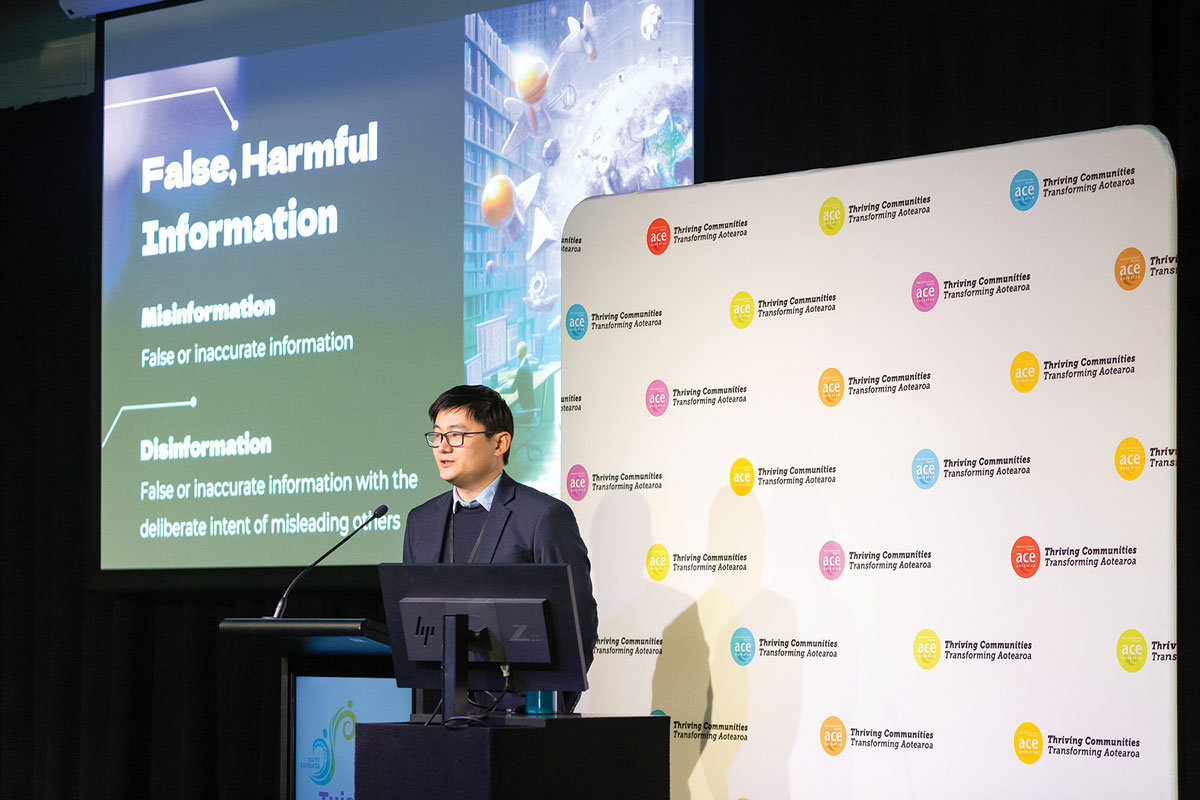
Day two of the ACE Sector Conference started with a fascinating session on misinformation and how to tackle it, presented by Dr Andrew Chen, an adjunct senior research fellow with Koi Tū; The Centre for Informed Futures.
The words disinformation and misinformation have rapidly become part of our daily language and are often used interchangeably, but as Andrew clearly pointed out, these words have two very different meanings and intents, with misinformation being the sharing of false information and disinformation being the deliberate intent to mislead.
Andrew shared some recent examples of situations where misinformation had significant consequences and he talked about the levers and situations that can ensure and support a rapid spread. These include:
- Epistemic superiority that places an individual's unwarranted belief or alternative viewpoints on equal footing with scientific evidence.
- Information vacuums where people fill gaps and spread information on channels like Reddit.
- Natural evolution of a story
- Fast digital vectors like the Internet where information can be quickly and easily shared.
- Unintended source, where people share information or make a mistake but don’t intend to cause harm.
And, many misinformation campaigns, either intentionally or unintentionally, have hooks in them that increase their ability to gain traction. Things like confirmation bias, emotional appeal, repetition and playing to that “need to belong” all contribute to whether or not we believe.
Andrew also shared ways to fight misinformation, through pre-bunking (see our story A Bit Sus later in this issue), the inoculation of people against misinformation, lateral reading where people are encouraged to go wide not deep, the identification of bad-faith tactics and adding value to truth and critical enquiry.
While much of this may seem quite depressing, Andrew ended on a high note, reinforcing his confidence in us as a society bedded in strong values to push back on both misand dis-information.