
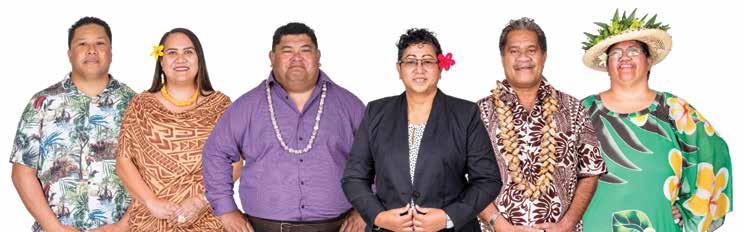
The Centre for Pacific Languages celebrates its 45th birthday next year and is now two years into a fresh approach, shifting from face-to-face language courses in Auckland, to online national delivery. Their flagship short courses (2 hours per week over 10-weeks) across seven Pacific languages (gagana Samoa, lea faka-Tonga, vagahau Niue, gagana Tokelau, reo Māori Kuki ‘Āirani, Vosa Vakaviti and Fäeag Rotuąm), are available at three levels (introduction, everyday conversation) plus two more advanced courses for Samoan learners wanting to understand the language and protocols of the fa’amatai. These are free community language classes, open to anyone with an interest in Pacific language and culture.
Another change has been the establishment of two income-generating services: Corporate Competency Training workshops for workplaces that have Pacific staff members, or who work with Pacific people and communities; and a translation service which is used both nationally and internationally.
The Centre also continues its key role as an advocate for policies which promote the revitalisation, maintenance and strengthening of Pacific languages and identities in Aotearoa New Zealand.
Until 2019 the organisation was funded by the TEC as an ACE provider. Now with funding from the Ministry for Pacific People (MPP) they have positioned themselves as a national organisation supporting the restoration of Pacific people’s identities through language and culture.
As their website says, ‘We are tautai or wayfinders, helping people recover their past, strengthen their present and envision the future through the restoration of the languages, cultures and identities’.
The Centre is the only NZQA-registered PTE providing free Pacific language classes (for anyone, not just Pacific people) in Aotearoa New Zealand. The change in delivery mode has meant a new approach – now delivery via online platforms is the norm. The Centre has four full-time employees who manage the organisation on a day-to-day basis, and a pool of about 30 part time/contracted Pacific language tutors, translators and cultural competency facilitators.
Tuiloma Gayle Lafaiali’i (MEd, BA Education) is the Centre’s CEO. She explains the reason for the recent changes, and their new approach:
“Stats NZ 2018 data shows that 65 percent of Pacific people living in Aotearoa New Zealand were New Zealand-born and the research indicates many NZ-born are disconnected from their culture and language. In one generation a language is lost and it takes three generations to reclaim it. So in 2019 the MPP published their Lalanga Fou report setting strategic goals, and language revitalisation which was identified as one of four key strategic areas designed to have Pacific peoples thriving in Aotearoa. Subsequently, CPL was able to secure new funding from the 2019 Wellbeing Budget. The government allocated $20 million over three years for MPP to support the development of services that support Pacific language learning and cultural identity. We received $3.9m funding from this pool and our big output is making our courses more accessible nationally.
“To help us achieve our goals we work collaboratively with the wider Pacific community language providers, educators and digital innovators to develop Pacific language resources to support language revitalisation. We continue to offer our short courses for free and we are looking to develop higher level fee-paying courses.
“We are working with MPP and the Māori Language Commission to determine how we ‘certify’ Pacific language experts here in Aotearoa for our professional translation services. At present we have huge numbers of Pacific children in language nests, and limited opportunities for transitioning to bilingual language programmes in schools. My daughter, for example, is learning Spanish because gagana Samoa is not offered at her school.”
The change in funding has given the Centre the ability to be more strategic in what they deliver.
“When we were funded by the TEC,” says Tuiloma, “we were rather stuck in a box – required to teach only people 16 years and over and run specific courses. The new funding has more flexibility and therefore allows us to think outside the box as to how, what and who we deliver to. The intent is more learner focused, so we now enrol 13–15-year-olds with parental supervision and we work on a number of initiatives to support Pacific languages in schools and ECE as well.
“This year we started our first gagana Tokelau course which has proven to be very popular, and in 2023 we are planning to develop courses in te gana Tuvalu and te taetae ni Kiribati for delivery in 2024.
“Our short courses are delivered via a weekly two hour Zoom lesson facilitated by a tutor. Students are expected to do at least one hour of their own study and practice as they work towards comprehension and fluency. All up, the courses involve 30 hours of learning. These courses are a good taster of the language to get students on the learning journey and motivated to continue with higher level classes. But 30 hours is not enough to gain fluency, so many of our students are return learners. Our goal is to provide them with enough learning and resources, so that they can then take the language into their homes and use it daily.”
The three levels are: An Introduction to Pacific Identity, Language, and Culture (NZQA Level 1, 3 credits); Everyday Conversation in a Pacific Language (NZQA Level 1, 3 credits); and Maintaining a Pacific Language and Culture (NZQA Level 2, 3 credits). The two Samoan only courses are Fa’amatai Bilingual, (NZQA Level 4, 3 credits), and Samoan oratory (NZQA Level 4, 3 credits).
“One constraint on course provision is securing experienced tutors. People can be fluent, but not teachers. All of our tutors are either qualified teachers, recognised language and culture experts and/or professional translators.
“Each year over 2000 people enrol in the various courses, but on day one we tend to lose about 25 percent of intended enrolments. Although language is identified as a high priority, students’ ability to attend class has been limited by Covid, as well as work and family responsibilities. This has been particularly evident over the past two years. Our completion rate has been around 50 percent. Almost a third to half enrol for a second time.
“Although completion rates are lower than desired, learner satisfaction with the course remains at 90% plus. Additionally, and most importantly, the data in relation to learners’ increased self-confidence, increased knowledge and ability to understand a conversation with their parents or grandparents remains extremely high. Eighty to ninety percent of those who have completed the programme say that they are now more confident in doing this.”
The 10-week online courses are, says Tuiloma, good taster courses and at the moment NZQA does not record credits from NZQA Training Schemes. This, they hope will come, and with the new funding the Centre is free to design more robust courses that will run for six months or a year.
The Centre is also working in collaboration with other organisations – to support and promote Pacific identity. For example they are working with the Auckland Museum on a singular project including providing resources for Pacific people to archive their photos and documents. They are also helping people to document their own migration and settlement stories about their move from the Pacific to Aotearoa New Zealand. “We are supporting our communities to ensure all this incredible history is saved.”
This year marks the start of the United Nations Decade for Indigenous Languages. It is designed ‘to draw global attention to the critical situation of many indigenous languages and to mobilise stakeholders and resources for their preservation, revitalisation and promotion.’ The recently refocussed Centre for Pacific Languages is now in a strong position to meet the challenge.