
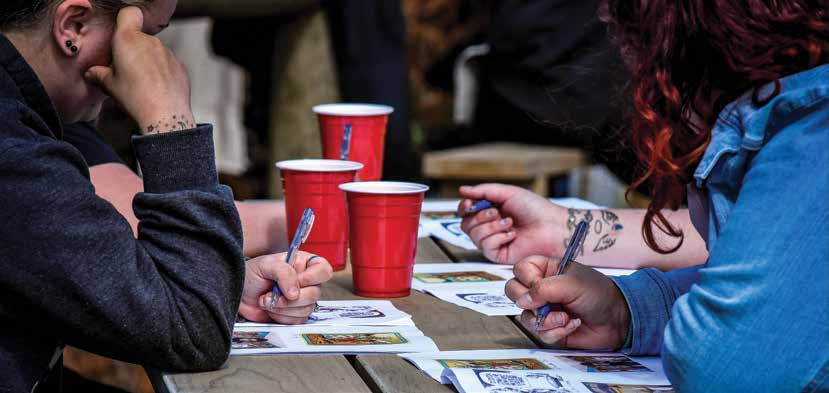
An ex-schoolteacher in a low decile school, Jade Ward (Tainui) is now running her own community education organisation – just out of Invercargill.
She set up the Reigning Downs Hauora Centre in late 2020 to help struggling school students of all ages, including NCEA students, to get the five key competencies listed in the NZ Curriculum – skills that Jade says, are essential to success.
These skills are: thinking (including problem solving), relating to others, using language, symbols and texts, managing self, and participating and contributing.
To teach these skills – alongside other essential life skills – Jade collaborates with high schools and community organisations. They send individuals or groups to the centre where rangatahi go through a tailor-made programme – first in a classroom, and then with some of her nine hōiho (horses), all of which are trained to competition level.
She offers five main courses: Relating to others and communication, I understand my anxiety; ‘Sensory’ (What works for me), I am Māori – I am proud, and LGBTQI – I belong. Otherwise programmes are designed to meet the specific needs of groups or individuals.
The pilot course was with the Murihiku Young Parent programme.
“I went and met them first,” says Jade, “and gave them a survey so that I could see their concerns and understand their issues. Their main anxiety was about how society sees young parents, so I created a programme around social influence and overthinking issues.
“I know a lot about every student before they come into the centre so that I can create a workbook for them. But I don’t probe about their pasts or behaviour. It is a clean slate when they come here. It’s all about building relationships.
“On day one we set goals and we revisit them regularly so every day they know that they are developing skills. At the end of every day they walk away with a feeling of success. That’s new to them.
“In the classroom we work on their learning issues. For example, if they have literacy issues, we might have a guided reading session. These are students who haven’t engaged at school. They’ve never known success in a classroom. Here it is new and exciting, and they take an interest in what we are doing.
“After the classroom work, we go out and they have the equine experience. You can learn a lot very naturally while working with horses. There’s a lot of global research that backs this up. For example leadership. Horses are driven by a leader in a herd, so they need a leader and that requires perseverance, problem solving, confidence, resilience, responsibility and dedication. Working with horses allows these qualities to shine through.
“Schools, I could see, are teaching everything backwards – as far as struggling students are concerned. There’s often so much going on in their lives. They need to be given the essential skills before they can be a confident learner, not pushed through NCEA.
“I am not a therapist. I’m not trained as one. I use education, which results in therapeutic benefits.”
About 60 percent of rangatahi who take part in her courses or who come for individual support are Māori.
“They don’t always recognise themselves as Māori,” says Jade.
“Many are unaware of their iwi or where they have come from. They have issues with academic learning and behavioural issues a well. So that’s why we push the values we hold here – the values that are so important – manaakitanga, whanaungatanga and hauora. They create a sense of belonging. Rangatahi come here and relate to these values. And they just love the food. I employ my Mum and Dad. Dad’s is an experienced horseman and Mum provides the food, conversation and hugs that play a vital role in creating our environment.
“The outcomes are humbling. Big milestones are achieved. We’ve had rangatahi who have never spoken to a teacher, standing up and addressing the whole assembly. We’ve had a student who was violent to teachers and whānau, now living openly with people. He never showed an ounce of violence here. Some have won awards for student of the week. It’s very rewarding.”
Kirsten Kean is a teacher at Central Southland College and last year she organised for a group of year 9 and a group of year 10 students who needed literacy support to go for a day with Jade in term three last year. The goal was to give them an experience which would help their writing skills and help them pass a unit standard on Equine Care, which is now available through Reigning Downs.
“Traditional classroom teaching doesn’t always work well for these students,’ she says. “Jade is a qualified teacher and knows how to build a relationship with students. They were out of school all day, doing something different – having a new experience. It was opening another door for them and working towards a Unit Standard on Equine Care was a major incentive. I was really impressed with their progress, both in terms of book work and their personal development. They absolutely do learn those essential skills.
“Unfortunately the country went into lockdown and the students did not complete the Unit Standard last year, but they will continue to work towards it in 2022. Having seen the benefits, Central Southland College will organise another group this year.”
And Jade has also worked with young people with a disability.
Linda Gilkison is the founder of Whanake House which provides a programme supporting social and vocational development for young adults with high functioning disabilities. She says that their learners have also benefited hugely from Jade’s programme:
“When they leave school, these young people are often socially isolated, and often fall through the cracks. I heard that what Jade is doing has huge benefits for young people who have anxiety and a lack of confidence – and that they can find that through horses. So we approached Jade and she set up a programme for us. It was a six-week block. About twelve went along on the first morning and they absolutely loved it. They looked at videos about caring for horses in the classroom, and then went out to groom and ride the horses.”
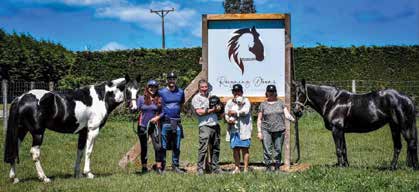 Denise Sanderson, who was the tutor accompanying the students says that there were great benefits: “There was a huge sense of pride in being in charge of something as large as a horse. They became calm and happy. They built an emotional bond with the horse. At the end of the session their self-confidence was huge, and when they got off the horse they were so proud about what they had done.”
Working with horses is naturally therapeutic, says Jade, so she has individual clients who have mental health issues like depression and anxiety and they benefit too. “Being a teacher I know when to push and when to let off.”
Most often her learners are ready to push themselves to learn and change because they feel totally supported in this whānau environment. Manaakitanga, whanaungatanga and hauora are present in every session. And it’s not just Jade – her parents, Mary and Ben are a big part of the success of Reigning Downs. Denise said, Jade’s mum was just wonderful. “When we left, we all wanted to go and give her a big hug.”