
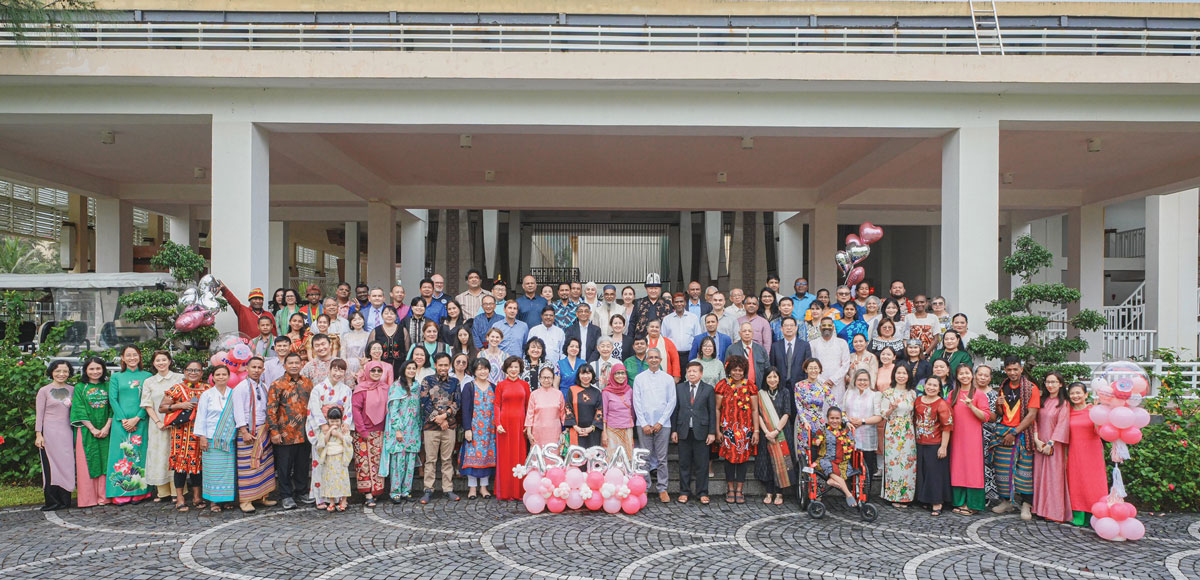
Helen Dabu, Secretary-General, Asia South Pacific Association for Basic and Adult Education (ASPBAE)
Brief Background:
ASPBAE and its Formidable Ties with ACE Aotearoa
Founded in 1964 in Sydney, Australia, the Asia South Pacific Association for Basic and Adult Education (ASPBAE) is a distinguished, long-standing education regional network of 251 civil society organisations and individuals across 30 countries in the Asia Pacific region. It has consistently worked towards securing the right of all to basic, youth, and adult learning and education of good quality, contributing to poverty eradication, social justice, gender equality, sustainable development and a lasting peace.
In its 61+ years of existence, ASPBAE has fostered a wide network of civil society organisations – community-based groups, national-level Non-Governmental Organisations (NGOs) and federations of education organisations, national campaign coalitions, academics and rights activists. These have been mobilised through platforms of cross-country exchange and learning to strengthen capacities in education good practice. ASPBAE has engaged thousands of adult educators and education advocates in numerous country-level and cross-country training, conferences, workshops, study visits, research, manuals and publications. These have covered a wide range of concerns, reflecting the diversity of the Asia Pacific context: for example, adult and women’s literacy, migrants’ education, gender equality, sustainable development, citizenship education, technical vocational education and training, and peace education.
While recognising the solid contributions of NGOs in education provision, ASPBAE has always maintained that governments are primarily responsible for securing the right to education and lifelong learning. ASPBAE has thus staunchly pursued advocacy work, promoting the adoption of effective education policies and programmes, backed by strong public financing. These efforts are supported by sound research, informed by rich education practices and collectively shaped by ASPBAE’s membership.
In pursuing its decades of work, ASPBAE has strongly worked with and leveraged the deep experience of Adult and Community Education (ACE) Aotearoa, which has now assumed the ASPBAE Presidency, represented by Peter Clinton Isaac Foaese, for the period 2025–2028. This ACE leadership in ASPBAE was formalized during ASPBAE’s 9th General Assembly in 2024 and was part of ASPBAE’s regional strategic planning workshop and 60th Anniversary celebration culminating event in Da Nang, Vietnam on 25–28 November 2024.
Looking Ahead:
Reading the latest threats and the critical role of ASPBAE and its members and partners in defending and harnessing the power of education in these turbulent and unprecedented times.
ASPBAE’s work in advancing a transformative education agenda within and beyond the Asia Pacific region through strengthened policies, financing and enhanced practice will remain a core part of its strategic directions, in close collaboration with its partners and members, including ACE Aotearoa.
In pursuing the work along these areas in the coming period, especially within the term of ACE Presidency in ASPBAE, attention should be exerted on the complex and intersecting contextual underpinnings for education.
Emerging contextual shifts and shocks are pointing to the following directions which will need to be accounted for in ASPBAE’s strategies for education in the coming period:
1) Reshaping of the Global Order, Risks of Wars, Emergencies and Crises – Intensifying Threats to the Sustainable Development Agenda with Barely Six Years Left to 2030.
The existing international rules-based order negotiated after the last world war which has helped preserve key principles of human rights and fundamental freedoms will be tested to its limits against ultra-nationalist and transactional tendencies of new power blocks of countries.
With barely six years left to the Agenda 2030 and the diminishing outlook for global-led processes and agreements, spheres of influence and engagements might lie more in regional and sub-regional blocs and processes, and will need to be harnessed further to continue demanding accountability for human rights and overall development agenda, including commitments to education. At the same time, it is still important to continue engaging in spaces at the global level to influence and collaborate with other development sectors, and monitor how the emerging world order will further impact education and development.
2) Dramatic cuts in aid to education and development in favour of increases in defence spending and inwardlooking domestic agenda of developed countries.
The ripple effect of USAID’s closure and the recent pronouncements of European governments in re-arming and increasing their defence spending will be felt in the medium to long-term at the cost of development aid, climate commitments and social cohesion agenda both at the national and transnational levels.
Fighting for financing of education and development will be more critical now than ever. ASPBAE, together with its members and partners, will need to build on its earlier efforts to challenge regression in education budgets and financing. It will need to continue challenging the growing influence of the private sector in education delivery and policy processes, especially when public financing and development aid are diminishing and the acceleration of technology allow for growing influence of private, for-profit technology companies. It will also need to continue strengthening its advocacy work towards greater domestic resources for education, especially calling for a more progressive tax systems that will pass on the tax burden to the richest population and companies and eliminate existing tax loopholes that allow for their tax breaks and incentives.
3) Rapid changes brought about by technology and AI in education, development and all life spheres.
With growing human dependencies on technology, including the rise of Artificial Intelligence (AI), much power and influence now lies more in the private sector. Unfortunately, policy developments and regulatory actions of governments are not catching up and failing to reinforce human-centred, regulatory, and protective mechanisms to both reap the benefits and minimise the risks posed by technology and AI.
ASPBAE will deepen its capacities and advocacy efforts on this front. It will continue to call attention to existing digital divides and hold governments to account on their responsibility to fully deliver the right of all to good quality education and not allow private sector holders of technology to undermine this right.
As recommended by its members, ASPBAE will promote the development of digital skills for women and marginalised communities to enhance their life skills, including marketcompetitive skills, bridge the gap in formal labour force participation, address the gender pay gap and promote economic empowerment for the most marginalised groups.
4) The rise of far-right and conservative/nationalist governments, and the regression on commitments to human rights, peace, freedoms, social and gender justice, equity and inclusion and climate justice.
There is certainly a chilling and shocking effect when a global power like the United States blatantly sets aside commitments to rights, freedoms and fundamental principles of diversity, equity, inclusion, as well as gender, social and climate justice.
Nevertheless, within the international community, there remains a stronger solidarity to protect long-held principles of human rights, justice and equality. Further, the wider social movements for education and development, including ASPBAE and its national, regional and global partners, will still persist and hold steady now more than ever, even amidst the threats of diminishing funding for civil society work. Existing intergovernmental policy spaces where ASPBAE and its members and partners are present will need to be defended, while also scrutinising parallel spaces that undermine a more representative process of engagement.
As the culture of divisiveness grows and is fuelled by the advances in digitalisation and wide range of technological platforms, ASPBAE will work closely with its partners and members, including ACE Aotearoa, in developing spaces for intergenerational and cross-sectoral discussions through learning collaborations, communities of practice and “think tanks”, to protect a transformative education agenda. It will also work with its members and partners, in challenging the far-right discourse and powerfully assert its analysis in advancing human rights, respect for diversity, the principles of equity, inclusion, as well as gender, social and climate justice.
There is no doubt that the complex and challenging social, economic, environmental and political contexts all point to the importance of protecting the right of all to good quality education as key in developing and implementing strategies for the acquisition of knowledge, skills and competencies that support children, youth and adults to cope with current and future challenges.
ASPBAE will be at the frontline in confronting these contextual underpinnings, sustained by its strong work with partners and members like ACE Aotearoa.