
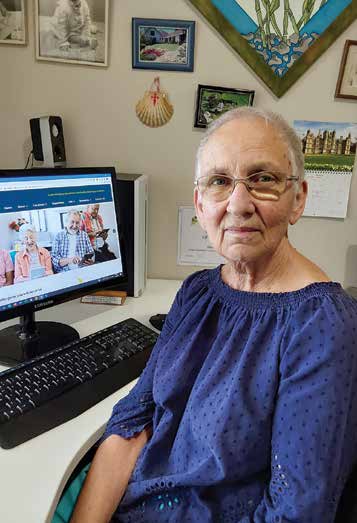
Volunteers working in SeniorNet centres have been teaching older people how to join the digital world and enjoy using technology for 25 years. There are about 54 centres, scattered throughout the country. They are membership organisations run by volunteers who are also over 50.
Today SeniorNet has several hundred volunteers helpingaround 8,000 members.
Most centres provide classes, learning and sharing sessions for their members, many of whom come to their centres on a regular basis to learn and to be with others. It’s a membership organisation which usually charges a small annual membership fee.
SeniorNet in New Zealand started about 25 years ago with a start-up sponsorship from Telecom. Since then it has grown and developed to include support from many corporate partners including Westpac, AMI, Chorus and Google.
Heather Newell came on board as Executive Officer in January 2020, an auspicious moment. It was just weeks before the whole learning environment changed. The pandemic arrived.
“I was well and truly in the deep end,” she says. “Our centres could not operate, and I realised that seniors could become extremely isolated. Not only that, but this was the time when banks announced the removal of cheques, and many government agencies were delivering services online. The 80 plus age group, especially, were terrified of the implications if they had no internet access, no technology access and no understanding of what ‘being online’ even means.”
Now into year three of the pandemic, she is still worried about this, but back in early 2020 she helped the organisation do what it could under the circumstances. They decided to provide an online meeting place – not just for members, but for any older person wanting to see other faces, have a chat and learn something new about technology – or in fact any subject. They call the sessions Senior Hangouts.
“It’s a virtual learning centre,” says Heather, “It provides a way for people to keep in touch. It’s not a formal classroom environment. This is much more about building trust and confidence while interacting with other people. A lot of our members are very tech-savvy and they come online for the social contact – and for their love of learning.
“Then there are those who are truly isolated. One participant who lives in a retirement village said ’I don’t even look to see what the session is going to be about. I attend regardless. I can’t go anywhere to see anyone. This is my lifeline.’
Vinay Karanam, the Project Manager for Senior Hangouts, piloted many different options to uncover the best time, the length of time seniors could concentrate online, the topics and the presentation styles.
“The socialising element is paramount,” says Vinay. “Some of the participants are in retirement villages or living alone. There are usually around 60 people in a session, with 40 regulars – and they greet each other and have a chat.
“First we have a welcome session, then a presentation which lasts for 15–20 minutes. Then the next ten minutes is for questions, discussion and sharing. Often the discussion time leads to further understanding or further questions that can be addressed at a later time.
“Anyone can make a presentation if they are interested in sharing their experience and knowledge with others. They just need to tell me, and I will put it on the website programme. I can help them work out the best way to make their presentation.
“From time to time we invite our partners, sponsors and representatives from government agencies to provide expert commentary on digital issues. Our partners, Westpac, AMI, Chorus and Google are concerned with online security, recognising scams, building confidence and trust in the digital world. And we also have lots of fun along the way.
“There have also been presentations from people like the Privacy Commissioner on how to keep information private, or migrant organisations on the rights of migrants, or sessions on health and wellbeing.”
In the first year SeniorNet had financial support from the commercial arm of Google, then in year two Google’s philanthropic arm agreed to fund it until July this year. Part of what they want us to achieve, says Heather, is to help other organisations with digital inclusion.
But the pandemic hasn’t been the only challenge. For the last few years an ageing demographic has provided some challenges.
“Recently when a centre said they were going to close, I visited them and found the husband who was the chair, and his wife who was the secretary were both 95! I felt terrible for pressuring them. This is a universal volunteering problem, so this year we are focusing on succession planning.”
Most of the centres, however, still have a good supply of volunteers, doing what they can under Covid restrictions.
In Warkworth, for example, they completely closed down twice – the last closure was from August 2021 until February this year. During this time help was provided online or by phone, or where possible by remote access. That might have solved problems, put probably didn’t teach seniors problem solving skills.
Now with the centre open again, seniors are voting with their feet. They can come in providing that they have a vaccination pass and wear a mask. Marilyn Goodwin who is both the Federation Chairperson and the Northern Regional Co-ordinator and who lives in Warkworth says that many of their 500 strong members are keen to get back to the old and much valued service:
“People are coming. Sometimes we have seven or eight people sitting at a coffee table and having a chat and waiting for their turn, but that’s a social time for them as well.
“If they need more help than can be given in these sessions, they will book a one or two hour slot with a tutor, one-to-one.
“A weekly newsletter keeps members informed about what’s coming up – including on SeniorHangouts. We are working hard at the moment to teach Zoom so people feel comfortable about online learning.”
The courses, (which have also started again) teach people how to manage their files and folders, use devices and portable computers, use their cameras, how to stream videos, and music, online security, smart homes and importantly – how to confidently use online banking services. Anything to do with technology.
“Recently I was asked about success stories,” says Marilyn. “Everyone that walks in is a success story. They learn something. They are more confident. The buzz that we get from that keeps us working year after year.”
And the national office is there to support the learning centres with technical support, administration, charity news, marketing and promotions. There’s also regional collaboration, which facilitates the sharing of tutors and local networking.
There are many organisations working in the digital inclusion space, but none focusing particularly on seniors with a philosophy of peer-to-peer learning.
“Our specific niche,” says Marilyn, “is seniors helping seniors – and it’s an important one. One woman told me recently, ‘I asked my daughter in law to show me how to do that. She took the device and did it – then handed it back to me!’ So seniors helping seniors is a really important aspect of what we do.”