
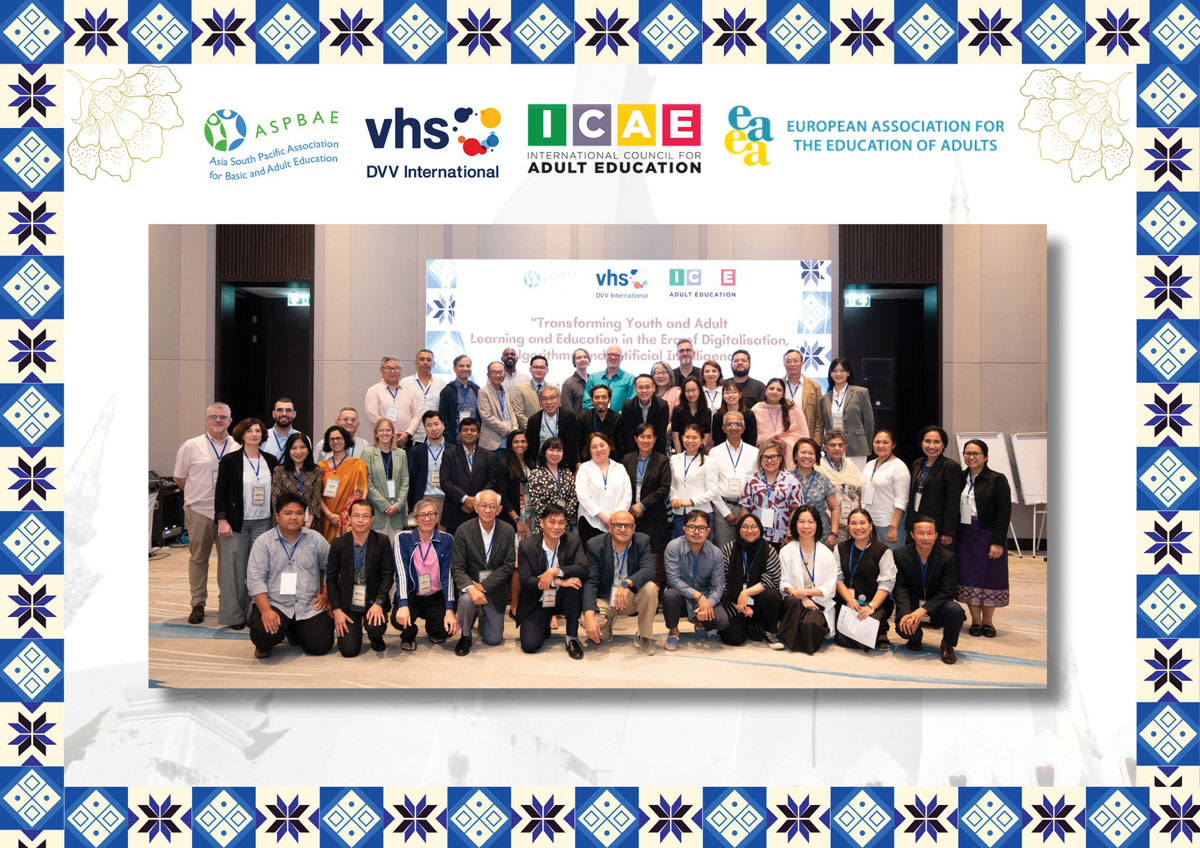
Late last year, youth and adult education leaders from across Asia, the Pacific and beyond gathered in Vientiane, Lao PDR, for the International Think Tank Meeting and Strategising for Education Stakeholders. The event, held on 24–25 November, brought together 62 participants from 23 countries across Southeast and Central Asia, the Pacific and South Africa. The meeting focused on how the fast growth of digital technologies, particularly artificial intelligence and algorithm-driven platforms, is reshaping the way people learn, work and participate in society with no sector untouched by technological change.
For adult and community education providers, this raises important questions about access, inclusion and ethics and Think Tank discussions centred on how the adult learning sector can respond in ways that protect human rights, strengthen communities and ensure learners are equipped with the skills needed to navigate an increasingly digital world. Three key priorities framed the Think Tank’s agenda. These were:
- Advocacy, strengthening national, regional and global efforts to influence policy so that digital transformation in education remains human-centred and grounded in principles such as equity, climate justice and the Sustainable Development Goals.
- Partnerships and ecosystem mapping, identifying the organisations and networks already working in this space and strengthening collaboration across sectors.
- Building internal capability, including improving digital literacy across organisations, developing hybrid and online learning platforms, and establishing an ongoing international forum focused on artificial intelligence and digitalisation in education.
ACE Aotearoa was represented at the Think Tank by Chief Executive Hannah Pia Baral, who contributed to discussions and facilitated the final panel session, and panellist Peter- Clinton Isaac Foaese who is ASPBAE President. Uwe Gartenschlaeger, Director and Chief Executive of DVV International – the global development arm of the German Adult Education Association and Robbie Guevara ICAE President were the other two panellists.
 All three highlighted the importance of building on existing networks and partnerships rather than starting from scratch and noted that strong collaboration across organisations remains essential. They also emphasised the need for clear and principled advocacy to ensure that conversations about technology lead to meaningful action. Throughout the discussion, the panellists returned to the importance of human relationships in learning and community work, noting that education systems must continue to support people who are often not represented in policy discussions, including rural communities, migrants, refugees, indigenous peoples and women.
The panel also reflected on the history of the global adult learning movement and the role that civil society advocacy has played in advancing lifelong learning. Speakers pointed to examples of community-led education initiatives influencing national policy and highlighted the revitalisation of indigenous languages, including te reo Māori, as an example of how education can strengthen identity and cultural sovereignty. Looking ahead, the panellists expressed cautious optimism about the future, emphasising the importance of intergenerational leadership, locally grounded approaches to advocacy and maintaining a strong focus on relationships and community voices as the sector navigates ongoing technological change.
Hannah also shared insights from the ACE Aotearoa 2025 AI conference.
“What struck me most was how much the conversations in Vientiane mirrored what our communities here in Aotearoa are already grappling with — how do we make sure technology serves people, not the other way around? It was a reminder that the questions our learners and providers are asking aren’t just local concerns. They’re global ones. And Aotearoa has real wisdom to contribute to that conversation,” said Hannah.
“The Think Tank was a valuable opportunity to exchange ideas with practitioners from different regions and to consider how international advocacy efforts can support local practice.
“The most powerful message from the gathering was that technology must remain a tool in service of people and communities and adult education has a critical role to play in ensuring that digital transformation supports inclusion, critical thinking and lifelong learning.”
Participants concluded the meeting by endorsing a Call for Action advocating for a rights-based, humanand planet-centred approach to youth and adult learning in the age of AI and digitalisation.
Read the Call for Action here aspbae.org