
Hashtags are often just aspirational, with few strategies in place to achieve them. The Ara Education Charitable Trust’s hashtag is “Together we change lives and build communities.”
And that’s what they are, gradually, doing.
Ara Education Charitable Trust (AECT) is a collaboration between industry, government agencies and schools to create work and training opportunities for South Auckland school leavers.
There are many partners – five South Auckland Schools (Aorere College, Mangere College, Manurewa High, Onehunga High and Southern Cross Campus), Auckland Airport, the Ministry of Social Development, Auckland City Council, and a number of other local businesses, including Level Consults which supply the old houses which are then sold on to the local community. More schools are getting involved.
Together they want to get South Auckland school leavers into construction. They know this will not only grow the local skilled workforce – it will increase household incomes.
And they want to show their community that there are paths to success that don’t require students to go from school into tertiary education. There is usually plenty of support for this transition. Ara is about providing the support needed to get a young person from South Auckland securely into an apprenticeship.
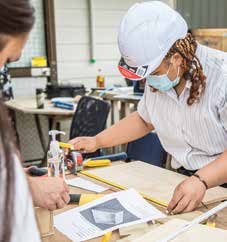 In particular they want to get young women into construction where they can get good pay and sustainable careers.
And Ara have named it – they want to be part of systemic change:
”Our core desire,” says Dr Sarah Redmond, the Schools’ Engagement Manager, “is to increase incomes in the South Auckland area and this is not solvable by any one group. We need the education side, the industry side and a big partner like Auckland Airport to get the systemic change that is needed to create a community. We need both top-down and bottom-up strategies to achieve real change.
“Once household incomes start to increase, everything else starts to stabilise. We are looking at long term systemic change – job stability and people being able to afford to live in their own community.”
AECT is part of the Ara Jobs and Skills Hub which was set up by Auckland Airport in 2015. The aim was to connect South Auckland communities with businesses working at and around the airport to fill the thousands of jobs needed to build and run ‘the airport of the future’ over the next 30 years.
When Covid struck a small team led by Dr Sarah Redmond responded by launching both their House Renovation and their Pasifika Women in Construction projects. The support includes providing career education, teaching them skills, providing work experience, helping them get their driver licence and providing any other support they need to get a job. This can be in the form of contract work, apprenticeships and full-time employment.
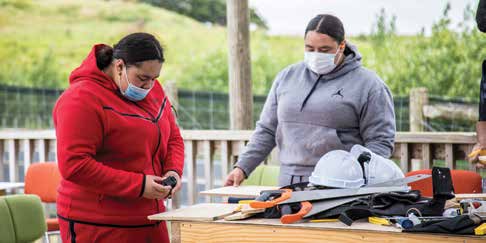
Currently the young people from the schools, (all of which have trades academies, so the students have the basics and an interest in a career in construction), come to a site leased by AECT cheaply from the airport and they work on relocated houses which were destined for demolition – and landfill. Waste minimisation is an important part of the kaupapa. Each house the project renovates, saves about 25 tons of waste going to the landfill.
The year 13 students come in at every stage – building, painting, plastering. They are also learning the skill of deconstruction, where houses that cannot be renovated are carefully deconstructed so materials can be reused.
Once finished, the refurbished homes become part of the housing stock for the community.
The Pacific Women in Construction project focuses on opening up the pathways for women into construction. Last year there were 25 young women in the programme. This year the numbers are reduced but growing.
Sarah Redmond says that it appears that many young Pacific women living in South Auckland may have left school and got jobs as quickly as they could to support struggling households. It’s a trend Ara plans to address – and even without a pandemic, this has its challenges:
“The young women on the programme all need quite intense mentoring, and we need to get funding for that, which can be difficult. Construction is such a male dominated work environment, and if young women are to succeed, mentoring is the key. We need to help the girls to surface issues and get the support they need. And we need to change the boys. A strong pillar of the programme is respect.
“It is also a fact that the girls often need more support in practical things. For example, young men are much more likely to get their driver licence early.”
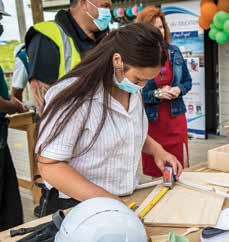 There are two Cadet Facilitators. Their role is to form trusting relationships with the students, especially the young women, and make sure that they are actively supported all the way through the programme. This will involve: meeting with the parents to address any concerns they may have and resolve (if possible) any issues that the students are facing at home; holding monthly workshops, where parents and girls can network and listen to other young women who have successfully made a career in construction and get some basic skill training in subjects like financial management; helping them get their driver licence; preparing them for an interview; and getting them connected with a suitable employer. Once the young women are in a job the facilitators continue to keep in touch, to make sure they are safe at work.
Mapa Elisa is one of the facilitators. As a young Pasifika woman herself, the programme has opened her eyes, “If I had this opportunity when I was in school it would definitely have been something that I would have considered.”
And that’s how it was for Meriam – who was a student at Onehunga College:
“I was not sure what I wanted to do and I was talking with my teacher about it. She suggested going into the trades programme. I feel like I have learned more in trades than in my high school years. I’ve definitely enjoyed the learning – watching others and learning what they do. When you’re a female some of the boys think that you can’t do it – that you’re not capable. But you definitely are.
“Mapa was always checking up by phone or text to see if we were OK, or if there was a problem. Recently she helped me resolve an issue with my employer.”
Now that she is part of the construction industry, Meriam’s goal is to be the first female to operate a difficult machine: “It’s a very skilled and well-paid job, and not many people master it. I’m determined to be the first female to do so. It’s going good so far.”
Sai Omosai, one of the two qualified builders teaching the students is not surprised that Meriam is so determined:
“Young women are good at planning and getting things done. The boys never look at the plans – so they end up looking at the problem! And the girls keep the boys busy! But really, we find that both groups are keen and ready to learn. They don’t waste time and they make the most of the opportunities we give them.”
AECT has a governance board which is made up of the five school principals as well as various highly experienced members who come from the financial, construction and education sectors. Pete Jones, Principal of Manurewa High School is currently the Chair of the Board:
“All of our Ara schools have a common purpose, to support our rangatahi to take positive steps beyond school. Recent MSD data is telling us that a significant number of our whānau are classed as ‘long term welfare’ beneficiaries. If we can transition our rangatahi into successful further education, training and meaningful employment pathways then we can help break this poverty cycle. The Southern Initiative report The Attitude Gap Challenge highlighted the disconnect between schools and employers in supporting students to make successful transitions into employment. At Ara we have developed innovative programmes and connections with business which address this issue.”