
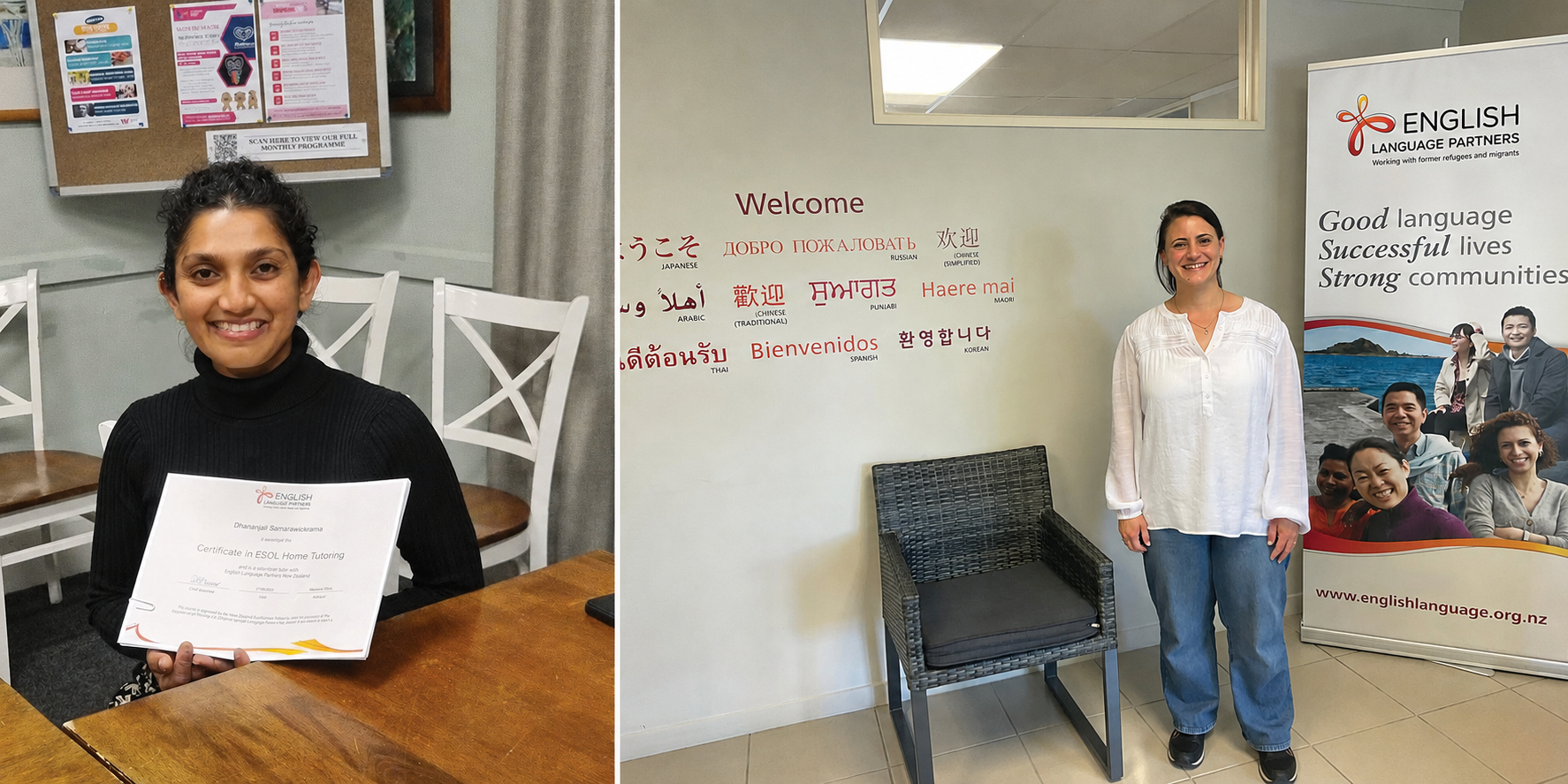
Every day across Aotearoa, volunteers transform lives through adult and community education. International Volunteer Day, marked globally on 5 December, reminds us to pause and celebrate their stories and the difference they make all year round.
One organisation at the heart of this work is English Language Partners (ELP). Founded by volunteers, ELP has grown into a nationwide not-for-profit organisation, helping people from migrant and refugee backgrounds to learn English to settle, work and succeed in Aotearoa.
Alongside English classes and groups, the original volunteer home tutor programme continues to thrive. Through a network of over 800 dedicated volunteer home tutors, ELP plays a vital role in empowering learners to become confident and independent members of their communities.
Volunteers complete training locally, at one of 21 ELP centres around Aotearoa, earning a NZQA-recognised Certificate in ESOL Home Tutoring. The training equips volunteers with the practical skills to confidently support adult learners in a one-to-one setting.
From learners to volunteers
At ELP, volunteers come from all walks of life and bring their own unique life experiences to the role. Some volunteers were once learners themselves. After building their English literacy skills, they become inspired to give back and support others on their English language learning journeys.
Dhana moved to New Zealand from Sri Lanka in 2023.A trained early childhood education teacher, she found work and joined an English for Employees class in Hastings to improve her English for the workplace.
“I’ve learnt a lot about Kiwi slang. I struggled a lot to understand the Kiwi accent at work and some Kiwi phrases my colleagues are using. Now I’m using them myself, I try to give it a go,” says Dhana.
“Also, we use many te reo Māori words and concepts at work. My class has really helped me to learn and understand them,” she adds.
Motivated to give back to her community, Dhana completed the Home Tutor training in 2025, and she attended the 2025 Hawke’s Bay Volunteering Awards, where ELP was a finalist.
“The free English classes and my tutor have helped me a lot here in New Zealand. I’m very grateful for it. Now I want to share what I learnt and help a migrant with their English,” says Dhana.
Like Dhana, Romi discovered that learning English was only the beginning of a much bigger journey.
Romi, originally from Argentina, arrived in Aotearoa three years ago with an academic and professional background. For her, learning English wasn’t just about mastering a new language – it is about reclaiming her voice, reconnecting with her identity and opening the door to a future life in Aotearoa.
Through her own experience and her work with others, Romi has developed a strong sense of purpose. “I want to teach English,” she says.
“I realised there are so many women who struggle with English. They were professionals in their countries but gave up their careers here. They’re overqualified but can’t validate their professions without English. It’s a high barrier.”
Romi now volunteers as a home tutor in Tauranga, supporting a Cambodian learner who speaks Khmer and Thai. “I’m so proud of her,” Romi says. “She struggles with reading and writing but speaks well. She does lots of homework.”
“There should be a way to help them. It’s also good for New Zealand,” says Romi.
Conversations that change lives
For the past eight years, Lower Hutt volunteer Hugo has supported newcomers to Aotearoa through simple but powerful means: connection and conversation. Hugo began volunteering after he retired, motivated by the negative attitudes he was seeing toward migrants and wanting to offer something constructive.
“To support an immigrant was my stand against the negativity,” he says.
His teaching approach is relaxed and relationship-focused. Rather than sitting at a table with worksheets, Hugo and his ELP learner meet each week to walk and talk. Their walks help his learner navigate everyday Kiwi life, from local issues to cultural differences while building a friendship that eases the challenges of settling in a new country.
Hugo draws on his background as a former early childhood teacher, prioritising encouragement over correction. “We don’t want to discourage. Encouraging the conversation to continue is more important than getting everything right.”
He believes that true progress isn’t measured in tests or milestones, but in connection. “It’s more friendship than pupil and kaiako — that’s why we are called English Partners.”
Many ELP volunteers have dedicated decades of service. Nancy is a shining example, volunteering in Hamilton for an incredible 29 years.
She takes pride in creating a safe, welcoming space where learners can speak freely about their lives, cultures and the unique challenges they face.
“You can have some hilarious conversations about things. Nothing’s bad – everything is on the table,” says Nancy.
Lessons often cover practical topics that learners from migrant and refugee backgrounds find most useful. One conversation even saved a life when Nancy shared a story about a relative who had battled breast cancer.
For Nancy, tutoring English was never just about vocabulary and grammar. “Learning straight grammar was too boring for students,” she says. Instead, she developed her own casual, conversational style that builds confidence, trust and lifelong friendships.
Stories like these show the incredible diversity and dedication of volunteers in the adult and community education sector.
Supporting volunteer training
ELP volunteers are well supported through training and ongoing professional development, with access to resources and guidance from Volunteer Leaders – ELP staff dedicated to working with volunteers. Volunteers also join a network of local and national peers across Aotearoa, collaborating online and connecting in person to learn from one another.
As part of ACE Aotearoa’s ongoing commitment to supporting volunteer-based programmes, ACE Aotearoa was pleased to provide funding for a crucial health and safety video resource developed by ELP. The video was produced in collaboration with Lance Burdett from WARN International, an expert in resilience and personal safety.
In the video, Lance talks to volunteers about a wide range of safety protocols, including having a charged mobile phone at all times. Volunteers are shown how to assess safety before arriving at a tutoring session. For example, this could be a risk caused by flooding during a severe weather event.
ELP’s National Volunteer Advisor, Inge De Leeuw, says volunteering with ELP is about much more than tutoring English.
“It’s about building genuine community connections, learning from diverse cultures, and contributing to a more inclusive and welcoming society,” she says.
Inge and ELP's 21 Volunteer Leaders around Aotearoa often hear from volunteers that the experience is deeply rewarding. “Volunteers tell us the learning goes both ways – they gain a huge amount out of this experience too.”
“For learners, having a tutor can be truly life-changing. We’re incredibly grateful for the contribution volunteers make, and we value them as an essential part of the ELP whānau.”
If you’re interested in volunteering with English Language Partners, visit their website to find out more and apply: englishlanguage.org.nz/volunteer